
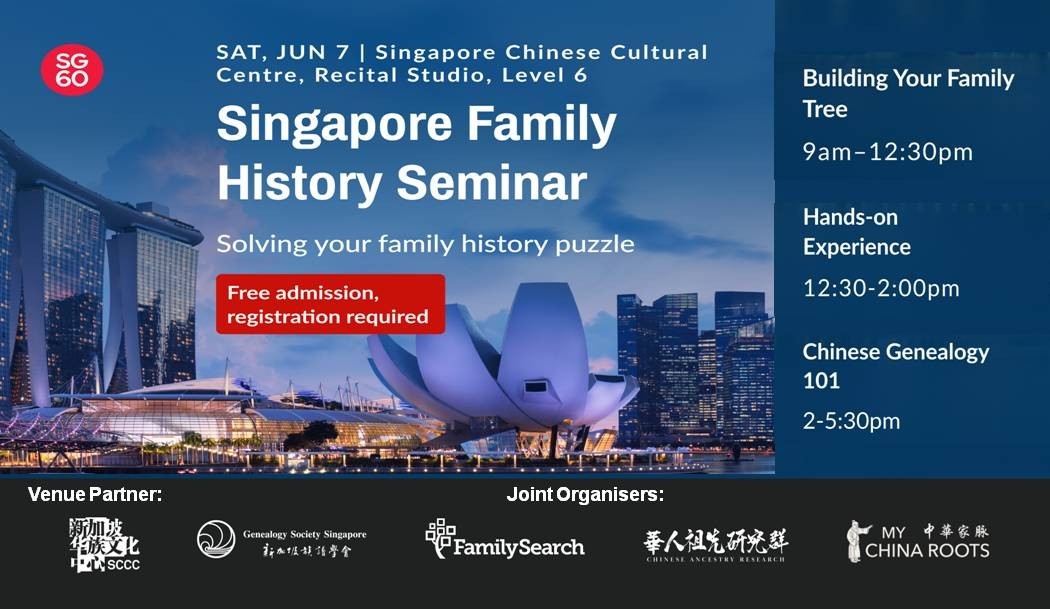
Date: Saturday, 7 June 2025
Time: 9 am – 5:30 pm
Venue: Singapore Chinese Cultural Centre, Recital Studio, Level 6
Organiser: Genealogy Society Singapore, in collaboration with FamilySearch International, Chinese Ancestry Research and My China Roots
Guest of Honour: Mr Eric Chua, Senior Parliamentary Secretary for Social and Family Development and Ministry of Law
Singapore Family History Seminar – SG60 Special Event
To celebrate SG60, The Genealogy Society Singapore is organizing a Family History Seminar 2025 jointly with FamilySearch, Chinese Ancestry Research and My China Roots. The full-day event will be held at the Recital Studio of the Singapore Chinese Cultural Centre, our Venue Partner. This is the first time, four significant organizations involved in promoting genealogy and family history are sharing their expertise and resources with Singaporeans. It is a rare opportunity to learn, connect and trace your roots.
Join us for this free event. Register here.
The full-day seminar was held at their Recital Studio and saw both morning and afternoon sessions packed almost to full house. It featured a curated programme of expert-led sessions and hands-on workshops. Below is a summary of the speakers, their topics and key takeaways:
Opening Remarks
The seminar began with a warm welcome by Mr Ng Yew Kang, Founder and Immediate Past President of GSS. In his address, he reflected on GSS’ mission over the past decade to promote family history and genealogy research in Singapore. He highlighted the significance of this SG60 event in rekindling intergenerational storytelling and preserving cultural heritage. He also took the opportunity to announce the passing of the baton to Mr Ronney Tan Koon Siang, who takes over as the new President of GSS.
This was followed by a speech by Guest of Honour, Mr Eric Chua, Senior Parliamentary Secretary for Social and Family Development and Ministry of Law. In his speech, Mr Chua acknowledged that families are central and core to our nation’s strength, serving as important pillars of support in society. Seminars like this play a part in building a Singapore where every family feels valued and validated.
Start with What You Know: Family Tree and Memories
Brian Edwards – Portfolio Director, FamilySearch International
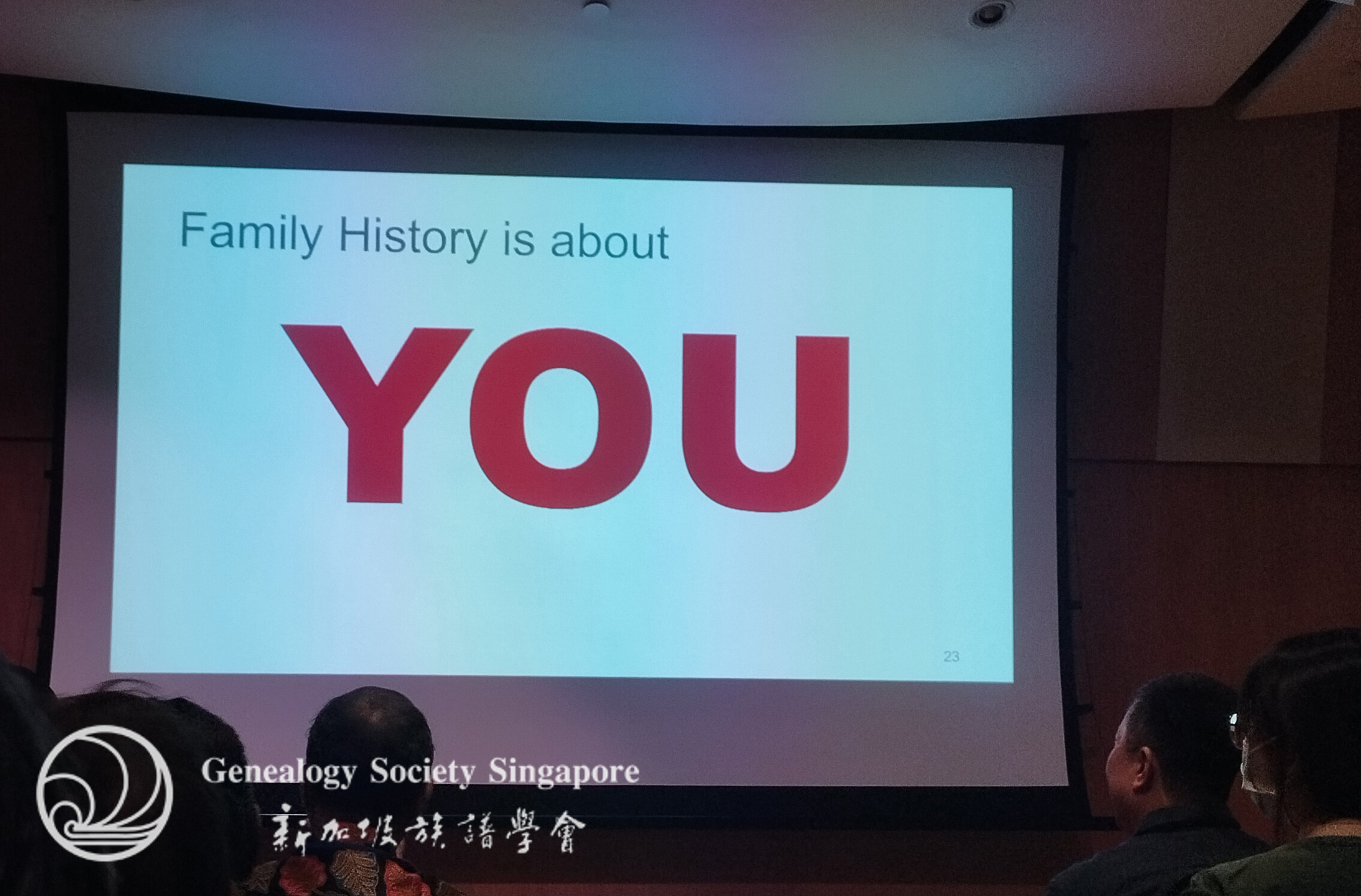
Family history is about people and relationships, and it’s important to document stories – both good and bad – as children become more resilient when they learn of how their ancestors overcame crises. Brian advised participants to begin with what they know and to write their own stories for the benefit of future generations. He also shared free online tools for capturing family memories and creating digital records.
Family Memory Books and Tree Designs
Eric Leach – Chinese Product Manager, FamilySearch International
Eric walked attendees through the creation of family memory books and introduced a variety of design techniques for visualising family trees. These created works are precious keepsakes that can be easily shared, and the hands-on activities are particularly useful for engaging youth and families with children.
Early Immigration, Birth, Death and Burial Records
Clara Poh – Archivist, National Archives of Singapore
Clara provided an overview of the types of historical records housed at NAS. In addition to birth, death and migration documents, it holds school records, maps and building plans, Straits Settlement records (“Blue Books”), oral interviews and more. She also covered NLB’s private records, publications and online resources and demonstrated how these sources can be accessed for personal ancestry research.
Tombstones and Buriel Records
Raymond Goh – Vice President, Genealogy Society Singapore
Known as a veteran tomb reader and finder, Raymond captivated the audience with the stories behind local cemeteries and burial customs, as well as his first-person accounts of tracing ancestral graves. Through sharing practical tips for interpreting tombstone inscriptions and burial record formats, he also raised awareness for the rich archival information found in the etchings of Chinese graves.
Basics of Chinese Genealogy
Eric Leach – Chinese Product Manager, FamilySearch International
Eric explored fundamental concepts in Chinese genealogical research, teasing out differences between Western family trees and Chinese genealogy records, and offering possible benefits of combining both. He also demonstrated how their software, with customisations for Chinese genealogy research, can be used for surfacing new insights.
Leaving No Stones Unturned
Nathan Co – Founder, Chinese Ancestry Research & Genealogy Advisor, GSS
Through the example of his own personal journey to discover his family roots, Nathan illustrated key principles of often-overlooked elements in Chinese genealogy research. His advice is that the whispers of ancestors should not be ignored. Through sharing case studies of successful family reconnections across countries, he reinforced the importance of persistence in tracing elusive family lines.
Introduction to Jiapu: How to Find and Read Your Jiapu
Huihan Lie – Founder & CEO, My China Roots
The jiapu (Chinese genealogical records) has been called the holy grail of family genealogy research. Huihan introduced its content and structure, explaining how to identify and interpret family lineages within these documents. He offered practical advice on where and how to locate them and did a live demonstration of digital tools that are tailored to the needs of Overseas Chinese and diaspora.
Hand-on Activity
For participants who were keen to start constructing their own family trees, the FamilySearch team was on standby during the lunch break to familiarise them with the use of the software.
Q&A
Wrapping up the day’s talks and workshops was an engaging Q&A session with a panel of four experts: Raymond Goh (GSS), Nathan Co (CAR), Eric Leach (FamilySearch) and Huihan Lie (MCR) – a rare opportunity indeed to tap on their combined knowledge and experience.
Closing Remarks
The seminar concluded with an address by Mr Ronney Tan, President of GSS, who commended the speakers for their rich and inspiring contributions. He noted the enthusiasm and curiosity displayed by the attendees and reiterated GSS’ commitment to continue public education on genealogy in Singapore.
Conclusion
The SG60 Family History Seminar was a resounding success, both in turnout and impact. It brought together a vibrant community of heritage seekers – indicating a growing public interest in family history here – and reaffirmed the importance of knowing one’s roots in the shaping of Singapore’s cultural narrative. By featuring both local and international experts, the seminar also laid a strong foundation for future collaborations, in furthering the field of family history research, in multicultural Singapore.
The seminar drew a diverse audience comprising:
- Elderly participants keen to preserve their family legacies
- Younger adults starting their genealogy journey
- Researchers, educators and students from local universities
- Families attending together
Feedback was overwhelmingly positive. Attendees praised the clarity of presentations, the usefulness of workshop materials and the speakers’ approachability. Many expressed interest in follow-up events or community support groups for continued learning. The lunchtime hands-on workshop was also well received, with several participants managing to begin their own family trees during the session.
Some feedback and suggestions for future seminars:
- Bring programmes such as this seminar to the heartlands so more people can benefit from such activities.
- Customise sessions to varied knowledge levels by specifying if the talk/workshop is targeted at beginners or intermediate researchers.
- Schedule Q&A after each talk (instead of at the end) as questions are fresh on everyone’s minds.
- Continue using QR codes in presentations to link participants directly to relevant resources.
- Broaden topics and research tools to include tracing family roots in Southeast Asia.